Health and Safety Policy for Landscape Gardeners
This Health and Safety Policy sets out the practical measures that landscape gardeners, garden landscapers and landscaping contractors will follow to protect staff, visitors and clients. The aim is to provide clear safe systems of work for routine tasks such as planting, turfing, pruning and small-scale construction, and to ensure that all teams are competent, equipped and able to deliver work while minimising harm. The policy applies to every member of a landscape gardening team, whether employed, freelance or subcontracted.Scope and Responsibilities
The policy covers on-site activities, workshop and vehicle safety, and safe handling of tools and materials. Managers and supervisors are responsible for implementing and monitoring it, while each landscape gardener has a duty to follow instructions, wear required protective equipment and report hazards. Supervision should be proportionate to the task and experience of the worker, and competence must be demonstrated before operating powered equipment or using hazardous substances.![In a well-maintained garden, a gardener wearing colorful floral gloves is planting a red flowering plant into freshly turned, dark soil. To the left, there are two hanging terracotta pots filled with blooming purple and white petunias, supported by wooden frames. Behind and around the planting area, lush green foliage and ferns provide a dense background, with some vertical garden supports or trellises visible. A small hand trowel rests on the soil beside the gardener, indicating ongoing planting work. The scene captures a typical outdoor garden space in the UK during daylight, with natural light illuminating the vibrant plant colors and rich soil, emphasizing the attention to detail involved in gardening and landscape maintenance. The image reflects professional gardening activities suitable for a landscape gardening service based around the [POSTCODE] area, focused on outdoor planting and garden enhancement tasks.](/pub/_photos/gardening/f1316470784.jpg)
Core Safety Principles
Core principles include thorough risk assessment, hierarchy of controls, and clear communication between garden landscapers, clients and third parties. Typical controls include:- Elimination or substitution of hazards where possible.
- Use of collective controls, such as barriers and signage, to protect passers-by.
- Provision and use of appropriate personal protective equipment (PPE), including gloves, eye protection and hearing protection.
Risk Assessment and Job Planning
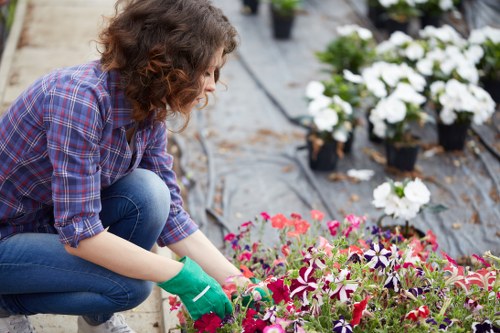
Every task must be preceded by a site-specific risk assessment that identifies hazards such as uneven ground, overhead services, manual handling risks and proximity to pedestrians or traffic. Job planning should consider weather, site access, safe storage of materials and emergency egress. For more complex landscaping works, detailed method statements are advisable so that landscaping contractors and grounds maintenance crews have a shared understanding of sequence and safety measures.![A close-up view of a gardener planting yellow and red tulips in a well-maintained garden bed with rich, dark soil. The gardener, wearing a grey and beige knitted sweater and blue jeans, is kneeling on a stone pathway, carefully placing the tulip bulbs among green foliage. To the right, there is a bush with red and green leaves, adding colour contrast to the scene. In the background, the lawn area features lush, evenly cut grass, bordered by a low brick edging, typical of a residential back garden in the UK. The garden appears tidy and organized, with a mix of flowering plants and evergreen shrubs, under natural daylight, indicating a clear weather day. The overall environment suggests ongoing gardening activities typical of professional landscaping or gardening maintenance, supported by local garden care specialists such as Landscape Gardeners, serving the [POSTCODE] area near [TOWN].](/pub/_photos/gardening/f1409007616.jpg)
Equipment, Tools and Personal Protective Equipment
Powered tools, chainsaws, chipper-shredders and compact machinery introduce significant risk and must only be used by trained operators. A routine maintenance and inspection regime reduces mechanical failure. PPE must be suitable for the task and in good condition: high-visibility clothing, protective footwear, cut-resistant gloves and face protection where needed. Records of training, equipment checks and PPE issuance help to demonstrate consistent safe practice among landscape gardening teams.Chemical and Biological Hazards
Herbicides, pesticides, fuels and some fertilizers present health risks if misused. Storage, mixing and application should follow manufacturer instructions and safe handling principles: use appropriate PPE, avoid drift onto non-target areas and ensure secure storage. Compost, soil and plant material can contain biological hazards; basic hygiene such as washing hands before eating and proper wound care reduces risk. Waste materials should be removed promptly and handled in a way that protects workers and the public.Manual Handling and Working at Height
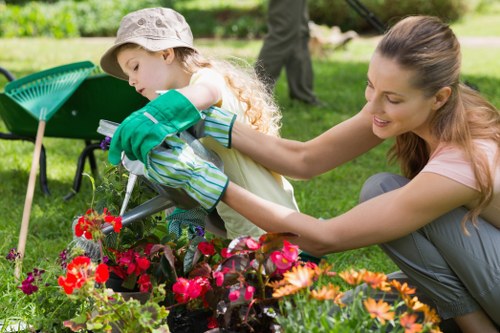
Manual handling remains a common cause of injury for landscaping operatives. Tasks should be organised to reduce lifting distances, use mechanical aids where practicable and rotate tasks to avoid repetitive strain. When working at height for tasks like hedge trimming or installing features, use appropriate access equipment and ensure that ladder and platform work follows safe systems. Planning is essential so that one-person tasks do not require unsafe improvisation.![A woman and a young girl in a well-maintained garden are engaging in planting or gardening activity, with various flowering plants and potted greenery in the foreground. The garden features a lush, green lawn area bordered by flower beds and shrubs, along with a pathway made of paving stones visible in the background. Tall trees providing shade and a wooden garden fence are also present, indicating a private outdoor space, possibly in a suburban area near [POSTCODE] or [TOWN]. The weather appears clear and bright, with sunlight illuminating the scene. Gardening tools and equipment, such as gardening gloves worn by the woman, suggest ongoing outdoor maintenance, consistent with services provided by companies like Landscape Gardeners specializing in garden care and landscaping. Natural tones of green, brown, and vibrant flower colours enhance the inviting and cared-for appearance of this landscaped backyard, reflecting a typical setting for residential gardening and outdoor upkeep activities.](/pub/_photos/gardening/f1317289984.jpg)
Emergency Procedures and Incident Reporting
Clear emergency arrangements are essential on-site. First aid provision should reflect the size and remoteness of the worksite, and staff should know who the appointed first aider is and how to summon help. All incidents, near-misses and hazards must be reported promptly so that lessons can be learned. An environment of open reporting encourages rapid corrective action and continuous improvement; managers should investigate promptly and communicate changes to the team.